

"Industrial finned tube heat exchangers are widely used in power generation, chemical processing, oil and gas, HVAC, and industrial cooling. Their extended fin surfaces increase the area available for heat transfer between the fluid inside the tubes and the surrounding air or process gas."
Explore finned tube heat exchanger designs and industrial applications to understand their uses and configurations.
However, fouling, corrosion, damaged fins, poor fin-to-tube contact, and unsuitable equipment selection can reduce performance, increase energy consumption, and cause costly downtime. This article explains how to diagnose these problems, select suitable fin designs, evaluate manufacturers, and improve long-term reliability.
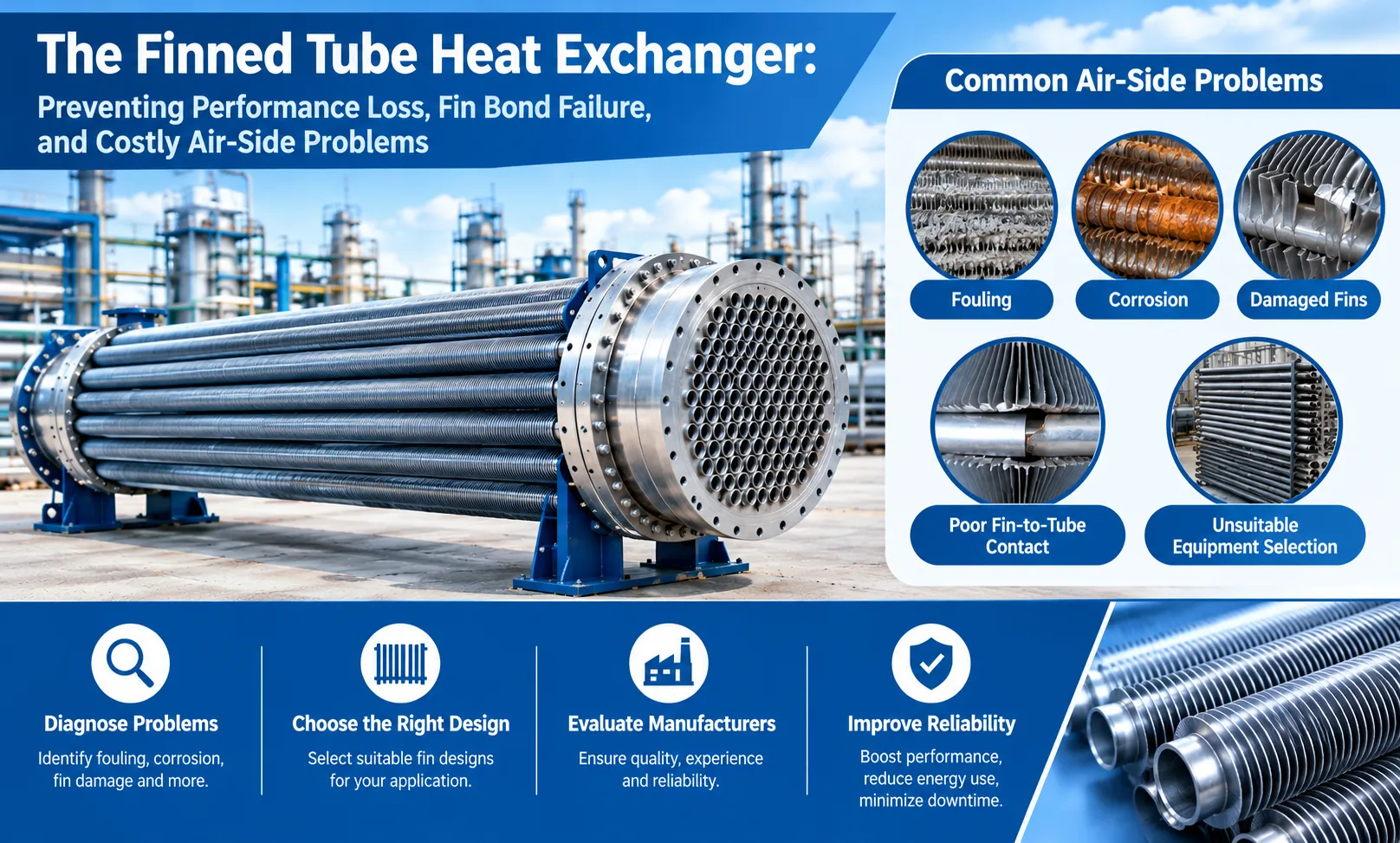
Reduced heat-transfer performance can result from fouling, restricted airflow, damaged fins, or changes in operating conditions. Identifying the cause helps prevent unnecessary repairs and replacement.
A finned tube heat exchanger requires effective heat transfer through the tube wall and fins, supported by sufficient airflow. Common causes of reduced output include:
Compare actual operating data with the original design conditions before selecting corrective action.
Deposits increase thermal resistance and restrict airflow, potentially raising air-side pressure drop. Uneven airflow can also reduce effective heat transfer across the exchanger.
For example, dust accumulation in an industrial cooler may prevent it from achieving the required outlet temperature, even when internal fluid flow remains normal.
Warning signs include:
Compare inlet and outlet temperatures, fluid flow, fan operation, pressure drop, and visible fin condition against the design basis.
| Observed problem | Possible cause | Recommended check |
|---|---|---|
| Reduced heat duty | Fouling or process changes | Compare operating and design data |
| Increasing pressure drop | Blocked fin passages | Inspect fins and airflow paths |
| Uneven temperatures | Poor airflow or fouling | Check fans and temperature patterns |
| Bent fins | Mechanical damage or aggressive cleaning | Inspect affected sections |
| Recurring performance loss | Fouling, corrosion, or design mismatch | Review maintenance history |
These symptoms indicate possible causes but do not confirm a diagnosis. Verify findings before repairing the equipment.
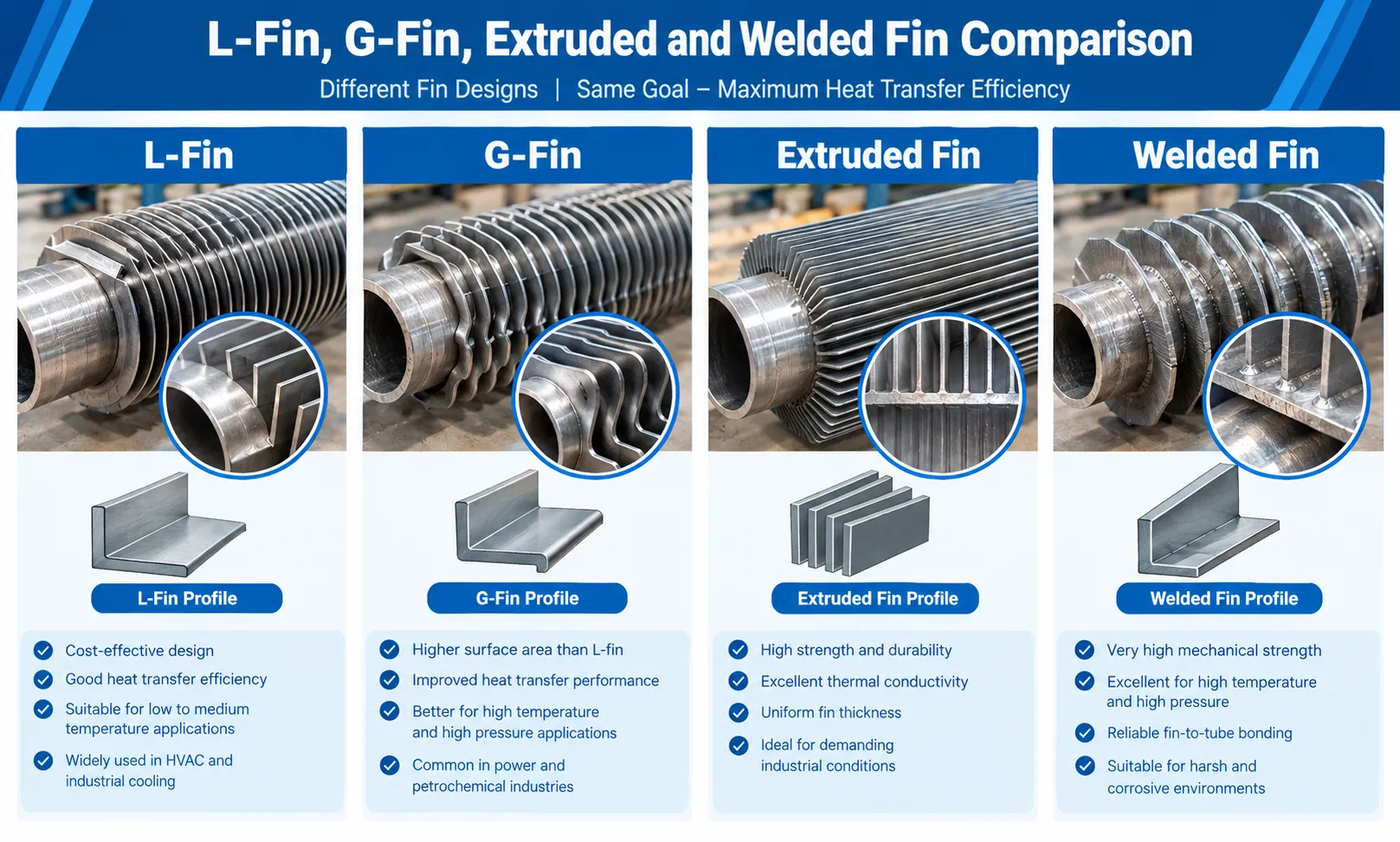
Fin selection depends on operating temperature, thermal contact, corrosion exposure, cleaning requirements, and expected service life—not simply surface area.
| Fin type | Construction | Main consideration |
|---|---|---|
| L-Fin | L-shaped strip wrapped around the tube | Often economical for suitable moderate-temperature applications |
| G-Fin | Fin mechanically embedded in a tube groove | Designed for improved retention and contact |
| Extruded fin | Fins formed from an outer metal layer around the tube | Integrated structure with potential corrosion-protection benefits |
| Welded fin | Fin attached using a suitable welding process | Suitable for demanding applications when materials and weld design permit |
Suitability depends on the exact construction, materials, operating temperature, and manufacturer's qualified limits. KL-Fin is another variation of wrapped-fin construction.
Thermal cycling causes expansion and contraction, while moisture, salts, and chemicals may accelerate corrosion.
Before selecting a fin type, evaluate:
For example, aluminium fins paired with a different base-tube metal may require careful corrosion evaluation in wet or salt-rich environments.
Higher fin density increases surface area but may restrict airflow and make cleaning more difficult. Fin height, thickness, pitch, tube arrangement, and airflow velocity must therefore be evaluated together.
Ask the manufacturer to provide:
The best design meets thermal requirements without unacceptable pressure drop or maintenance demands.
Heat must transfer from the base tube into the fins before reaching the surrounding air. Poor contact increases thermal resistance and reduces the fins' contribution to heat transfer.
Different fin and tube materials may expand at different rates. Repeated thermal cycling can stress the attachment interface, particularly when manufacturing quality or design suitability is inadequate. Vibration, mechanical impact, and excessive operating temperatures can also contribute.
Possible warning signs:
A visible gap alone does not prove bond failure; assess the condition using suitable inspection methods.
| Attachment method | Potential advantage | Important consideration |
|---|---|---|
| Wrapped fin | Simple, economical construction | Contact depends on design and operating limits |
| Embedded fin | Mechanical engagement with tube groove | Groove geometry and manufacturing quality matter |
| Extruded fin | Integrated fin structure | Material compatibility and extrusion quality are important |
| Welded fin | Mechanical attachment through welding | Weld quality and metallurgy require verification |
No attachment method is universally superior. Confirm suitability for the actual temperature range, materials, and service conditions.
Poor fin dimensions, inconsistent attachment, unsuitable materials, and manufacturing damage can reduce reliability. Depending on construction, defects may include insufficient contact, incorrectly formed grooves, discontinuous welds, or damaged base tubes.
Before ordering, verify controls for:
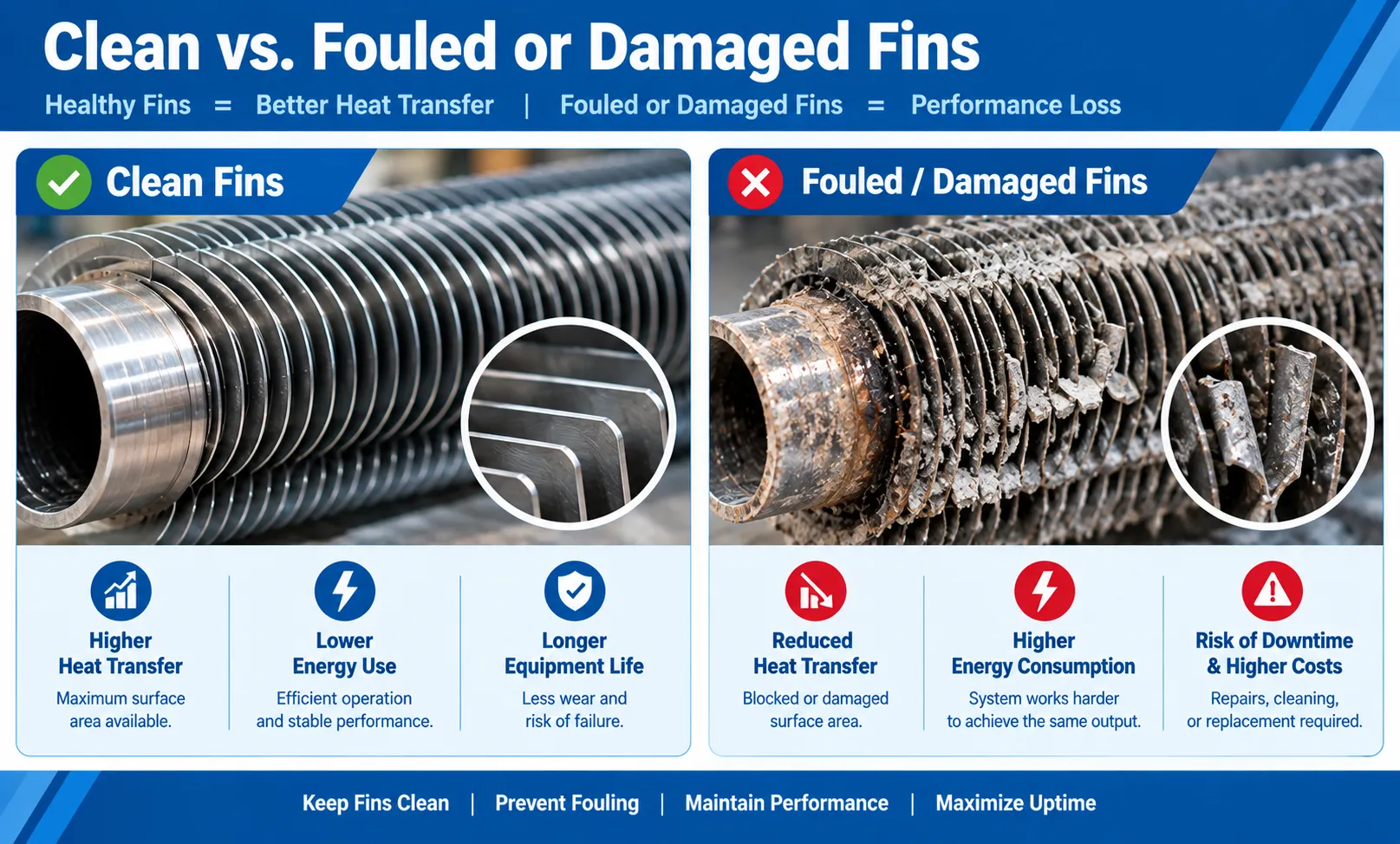
Even a well-designed exchanger can lose performance when its finned surface is poorly maintained. Preventive maintenance should address contamination, corrosion, mechanical damage, and cleaning methods.
Dust and fibres may accumulate in ventilation systems, while soot and process residues affect combustion-related equipment. Oil, sticky deposits, moisture, and airborne salts create additional cleaning and corrosion challenges.
Assess:
Use inspection findings and operating trends to establish an appropriate cleaning interval.
Excessive water pressure, incorrect spray direction, aggressive brushing, and incompatible chemicals can bend fins or damage coatings. Follow the manufacturer's approved cleaning procedure.
Finned tube cleaning checklist
Where possible, compare pressure drop and thermal performance before and after cleaning.
The decision depends on damage severity, base-tube condition, performance impact, safety, and repair cost.
| Condition | Possible action |
|---|---|
| Localised fin bending | Assess whether approved straightening is suitable |
| Surface fouling | Clean using an approved method |
| Localised corrosion | Determine extent before selecting repair |
| Tube leakage or wall damage | Assess repair, plugging, or retubing |
| Widespread deterioration | Compare refurbishment with replacement |
Not every fin can be repaired economically, and not every tube leak requires complete replacement. Follow engineering assessments, safety requirements, and manufacturer recommendations.
Before approving a supplier, verify technical suitability, materials, manufacturing controls, inspection requirements, and documentation.
Provide complete operating information in your request for quotation (RFQ):
Request documented design calculations, assumptions, acceptance criteria, and performance guarantees tied to clearly stated operating conditions.
Review approved specifications and the inspection plan before fabrication begins.
| Item to verify | What to request |
|---|---|
| Materials | Approved specifications and traceability |
| Fin geometry | Height, thickness, pitch, and tolerances |
| Attachment method | Manufacturing process and acceptance criteria |
| Corrosion protection | Coating and surface-treatment details |
| Fabrication quality | Inspection records and process controls |
| Performance | Design calculations and acceptance conditions |
| Deviations | Written approval for specification changes |
Inspection methods must suit the equipment and applicable requirements; no single test verifies every attachment type.
Request the applicable:
Confirm the required documents against the purchase specification and applicable construction code.
Initial price is only one part of total ownership cost. Frequent cleaning, higher energy consumption, premature corrosion, and unplanned downtime can make a low-cost unit more expensive over time.
Compare suppliers using equivalent operating conditions and technical requirements.
| Evaluation factor | What to compare |
|---|---|
| Thermal performance | Required heat duty |
| Air-side pressure drop | Pressure loss at specified airflow |
| Energy consumption | Fan and supporting-system energy |
| Materials | Suitability for the environment |
| Maintenance | Cleaning access and requirements |
| Manufacturing quality | Inspection and traceability |
| Delivery and warranty | Lead time, coverage, and support |
Greater surface area does not automatically mean better performance. Consider pressure drop, energy use, and maintenance alongside heat duty.
Consider the following lifecycle expenses:
Use realistic operating assumptions when comparing total ownership costs. A higher-priced option is worthwhile only when its expected benefits are supported by comparable data.
Before awarding the order, confirm:
Written confirmation makes supplier comparisons clearer and reduces misunderstandings after purchase.
Combine operating data, physical inspections, maintenance history, and original design conditions to detect deterioration before it becomes a major problem.
Monitor:
Compare trends over time and account for changes in ambient temperature, process load, and instrumentation.
| Suspected issue | Evidence to look for | Next step |
|---|---|---|
| Fouling | Deposits, blocked passages, rising pressure drop | Inspect and clean appropriately |
| Bond degradation | Loose fins or interface damage | Assess attachment condition |
| Corrosion | Pitting, material loss, coating damage, or leakage | Evaluate material integrity |
| Poor airflow | Fan problems or uneven air distribution | Inspect fans and air paths |
| Process change | Different inlet conditions, flow, or load | Reassess using actual operating data |
Symptoms guide the investigation but do not confirm the cause. Seek qualified engineering assessment when the diagnosis remains unclear.
Final inspection checklist
Adapt this checklist to the equipment, purchase specification, and applicable codes. It does not replace formal engineering review.
| Focus area | Key takeaway |
|---|---|
| Performance loss | Check fouling, airflow, process conditions, and fin condition |
| Fin selection | Match design to temperature, environment, and maintenance needs |
| Bond degradation | Verify attachment quality and thermal-cycle suitability |
| Corrosion | Assess material compatibility and protective coatings |
| Cleaning | Remove deposits without damaging fins |
| Manufacturer evaluation | Review calculations, specifications, and inspection records |
| Supplier comparison | Include energy, repair, cleaning, and downtime costs |
| Maintenance | Monitor trends and investigate recurring problems early |
Reliable finned tube heat exchangers require suitable fin selection, sound fin-to-tube contact, compatible materials, effective airflow, and consistent maintenance. Fouling, corrosion, and cleaning damage can reduce performance even when the original design is sound.
Plant engineers and procurement teams can limit avoidable costs by specifying operating conditions clearly, verifying manufacturer documentation, comparing suppliers on equivalent requirements, and monitoring equipment throughout its service life.
The goal is to select a finned tube heat exchanger that meets the required thermal duty, withstands its operating environment, remains maintainable, and delivers dependable long-term performance.
Need a custom process cooling system or a high-performance finned tube heat exchanger engineered for a harsh industrial environment? Connect directly with our strategy and design team to optimize your project lifecycle from initial concept development straight through to final field execution.
Director – Business Development & Strategy, HEFT Engineers Pvt. Ltd
Contact Number: +91 9769063942
Follow HEFT: HEFT Engineers on Instagram →